



For many people, privacy is of the utmost importance when browsing online. Users do not want companies harvesting their data, and using it for personalized advertising. So the recent news of Google phasing out third-party cookies for 1% of users, with a plan to completely do away with them by the end of 2024, should be a welcome change that consumers should accept. However, there is still skepticism surrounding what could ultimately replace cookies, as well as alternatives that are already being tested.
To understand consumer perspectives in these changing times, we surveyed over 1,000 U.S. consumers on the eve of these changes, January 3rd, and today, at CES 2024, we’re sharing these critical insights.
Email Address Skepticism
Adlook’s survey revealed 58% are positively influenced in their purchasing decisions by relevant ads. In contrast, 27% report rare influence, and 16% see no impact.
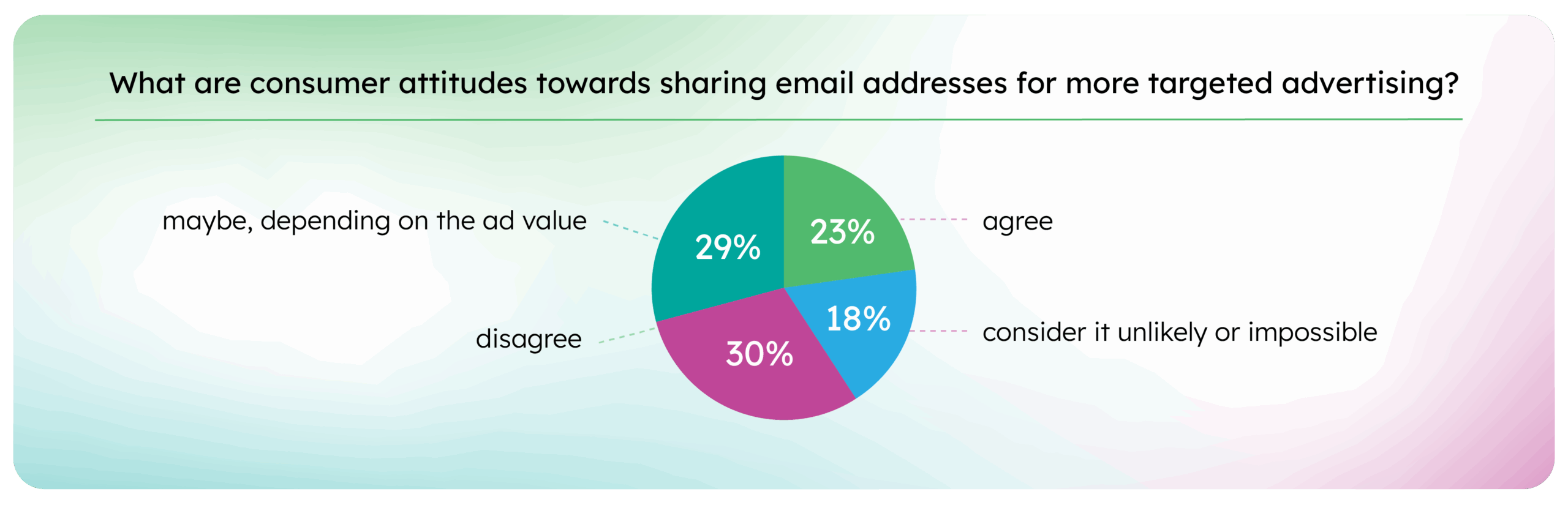
However, skepticism arises when consumers are asked about exchanging email addresses, which are becoming a popular alternative to cookies, for more or better targeted online ads. In fact, half (48%) were not in favor of sharing their emails for more targeted ads, with 30% prioritizing privacy and 18% considering it unlikely yet possible. Meanwhile, 29% expressed a conditional ‘maybe’ in sharing email addresses, depending on the ad’s value, and 23% agreed for better relevance.