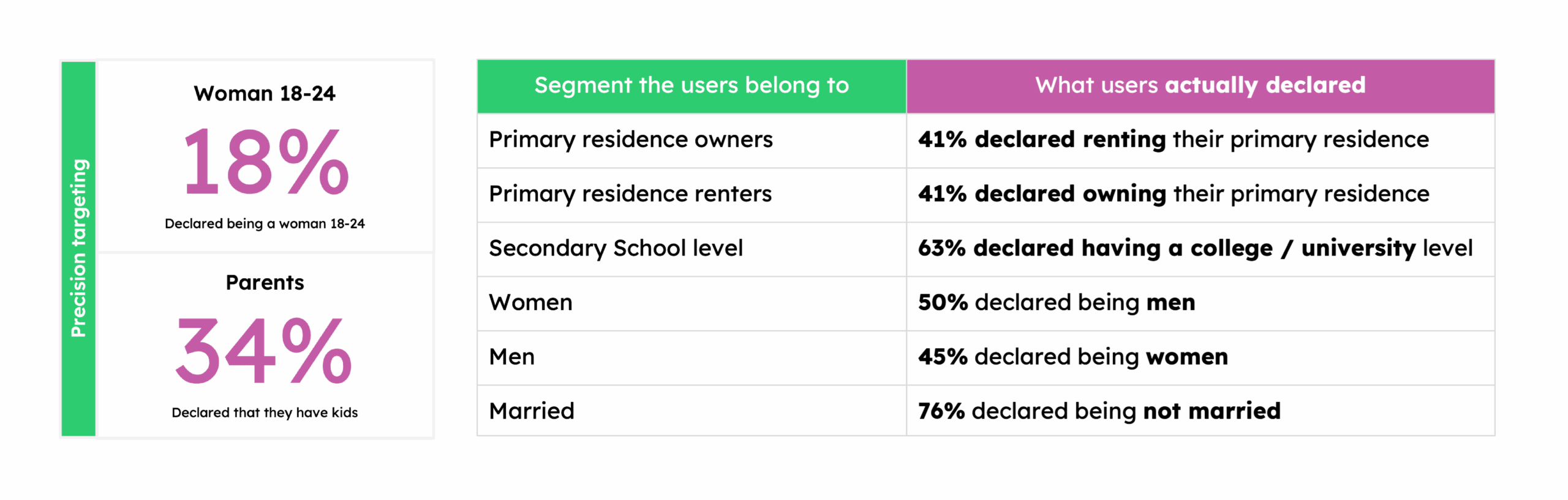
This level of inaccuracy challenges the traditional reliance on cookie-based targeting, raising uncomfortable questions about how much advertisers should trust segments built on third-party data. If these foundational identifiers are crumbling, what does that mean for the rest of our targeting and measurement strategies?
[We’re in a privacy-first era of marketing]
The shift from cookie-based targeting isn’t happening in a vacuum. On one hand, regulations like GDPR and CCPA have heightened consumers’ awareness of data use, while browsers like Safari and Firefox have long blocked third-party cookies. With Chrome soon following suit, many behavioral and retargeting strategies are increasingly difficult to execute. On the other hand, consumers have grown wary of ads that seem to “follow” them across the web. In this new landscape, marketers must find methods that deliver results without encroaching on consumer privacy. Here we face a new hypothesis: as personal data pipelines dry up, can approaches that don’t rely on intrusive identifiers step in and provide both efficiency and reassurance?
[New directions]
Despite 92% of UK marketers expecting no further delays to the end of third-party cookies, 73% admit they’re not fully prepared to operate without them [7]. Many are still developing first-party data strategies, concerned about identity solutions, and planning to spend more on the open web – underscoring the urgency of exploring new targeting and attribution methods [5]. As brands and publishers confront this “signal loss” era they’re weighing different paths forward. Two primary solutions have emerged: alternate ID frameworks and ID-less approaches. Think of it as a crossroads: one route tries to patch the holes in the old system with alternate IDs, while the other path embraces a radically different model that abandons user-level data entirely.
Alternate IDs aim to preserve user-level addressability through privacy-compliant identifiers, such as hashed (anonymised) emails, device IDs, or universal IDs from neutral parties. While these methods uphold a form of personalized targeting, they’re still anchored in user-specific data. Major backers include The Trade Desk (Unified ID 2.0) and LiveRamp (RampID).
Is it a viable fix, or just delaying the inevitable? Let’s weigh the pros and cons:
Advantages:
- Maintain user-level addressability
- Use privacy-friendly signals like hashed emails
- Offer continuity for brands accustomed to audience-based strategies
Challenges:
- Still depend on user data, raising trust and compliance concerns
- Require industry-wide participation to create meaningful scale
- May face future regulatory hurdles that restrict their usefulness
ID-less approaches, on the other hand, avoid user-level data entirely, relying instead on the context or environment to guide ad delivery. Beyond contextual targeting – focusing on the nature of the content itself – ID-less methods can tap into cohort targeting, geolocation, or timing signals to deliver relevant ads without revealing who the user is. Supporters of this model include Google’s Privacy Sandbox (Topics API), Apple’s SKAdNetwork & ATT, Oracle’s Contextual Intelligence, GumGum’s Verity, and Adlook’s suite of ID-less solutions like Deep Context, Deep Search, Deep Survey, and ContentGPT.
Does this signal a paradigm shift, where content and context become the new currency of ad relevance, dethroning user-based profiling?
Advantages:
- Remove reliance on personal identifiers, inherently protecting user privacy
- Rely on content-based or macro-level cues like location or timing for relevance
- More resilient to regulatory changes and evolving browser policies
Challenges:
- Requires marketers to adopt new strategic frameworks, leaving behind conventional cookie-based segmentation
- Need for more sophisticated, context-sensitive solutions to maintain relevance and accuracy
- Demand investments in new technologies to prove effectiveness
While alternate ID frameworks try to reconstruct traditional targeting models through new identifiers, ID-less approaches embrace a world without personal signals. Instead, they tap into what’s happening in the moment – on the page, in the environment, or at a given time – to determine which ads make sense. By eliminating unique identifiers, these strategies can function seamlessly across platforms and publishers without eroding trust.
Let’s deep-dive into one particularly promising ID-less strategy poised to transcend these challenges: contextual targeting. Can it rise above the chaos and claim its place as the new standard in a privacy-first era?
II. The Contextual Renaissance: Redefining relevance without personal data
As the value of third-party cookies diminishes, contextual targeting – an approach that predates advanced data-tracking methods – is enjoying a renaissance on the open web. According to IAB Europe and Xandr, nearly three-quarters (74%) of European advertisers plan to leverage contextual targeting once third-party cookies and device identifiers are gone [3]. Is this just nostalgia for simpler times, or could contextual targeting offer a genuinely superior way to match messages with moments?
[Definition]
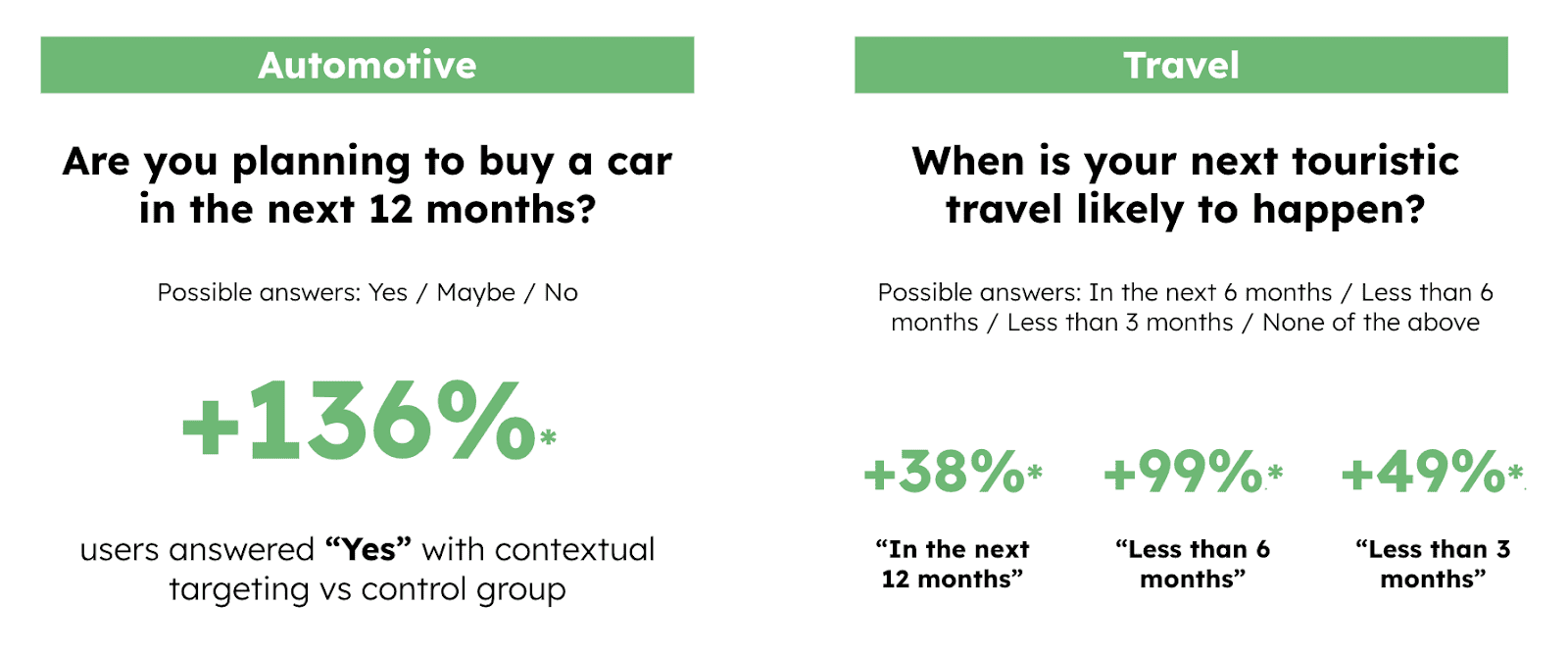
At its core, contextual targeting aligns advertisements with the content of a given webpage or app environment rather than with a specific user’s profile. Instead of deducing who the user is or what their past behavior might imply, it pinpoints where they are now – showing, for example, an SUV ad on a page about road trip destinations. Here, relevance flows naturally from the environment, enhancing brand impact, and capturing attention at precisely the right moment.
[Relevance backed by consumers – Consumers demand better user experience]
Today’s users, fatigued by relentless tracking and irrelevant ads, welcome contextually relevant messaging. According to WARC, 72% of consumers consider contextual relevance an essential factor in the ads they encounter. In the UK, 81% prefer online ads that complement the content they’re viewing, and 65% feel more favorably toward brands that get the context right [1]. By tapping into the moment and the meaning of the page, advertisers can forge stronger emotional connections, meeting audiences on their own terms.
[Brand suitability solution]
Contextual targeting isn’t just about respecting privacy or serving more personalized ads – it’s also a powerful safeguard for brand integrity. Traditional audience-based methods can place ads alongside content that’s inappropriate or off-brand. By contrast, contextual targeting ensures that ads appear in brand-safe environments. On the open web’s vast and varied landscape, this capability is invaluable. Advertisers can achieve scale without compromising contextual fit, reducing reputational risk, and bolstering consumer trust.
[New tech = New level of contextual]
This contextual renaissance is not just a nostalgic return to older methods; it’s fueled by powerful machine learning, natural language processing (NLP), and cognitive technologies that can interpret webpage content at scale. Leading industry players have developed sophisticated algorithms to battle the challenge of ad relevance and targeting precision. These tools understand language nuances, detect sentiment, and identify brand-suitable environments.
Advertisers can now target not only simple keywords but also entire concepts and categories, ensuring that the message fits the contextual frame and tone of the content. The result: richer, more meaningful ad placements that feel less intrusive and more like a natural extension of the user’s browsing experience.