
Adlook Welcomes Industry Veteran Jakub Kossut as Global VP of Market Entry Strategy
Kossut brings 20+ years of experience to support Adlook’s commitment to superior innovation and continued expansion

In the world of online marketing, socio-demographic targeting has long been the cornerstone of campaign strategies.

1. Purpose of the study
In the world of online marketing, socio-demographic targeting has long been the cornerstone of campaign strategies. By segmenting audiences based on factors such as age, gender, income, and education, marketers have sought to deliver tailored messages that resonate with specific groups. However, the accuracy and reliability of this data have been increasingly questioned. Can we truly rely on socio-demographic profiles to guide marketing efforts, or are we missing the mark by overestimating their precision?
There are several reasons why socio-demographic data might fall short in capturing the true essence of a target audience. For one, when data is inferred by algorithms. These algorithms attempt to predict users’ demographics based on their online behavior, browsing history, and other digital footprints. However, these predictions can be flawed due to outdated models or incorrect assumptions, leading to significant inaccuracies.
Additionally, a substantial portion of socio-demographic data is outdated. Data collected at a single point in time may no longer reflect an individual’s current situation, as life circumstances and preferences evolve over time. This lag in data relevance can severely undermine the effectiveness of targeting efforts. Furthermore, the user of a shared device at a given time might not align with the initial socio-demographic segment, amplifying the risk of inaccuracies, particularly with older data.
Finally, providers may estimate socio-demographic information based on general audience extrapolation. Rather than having precise data for every individual user, providers make assumptions about their audience as a whole, using aggregated statistics and broad patterns. While these estimates might capture trends, they often overlook the diversity and complexity within the audience, leading to oversimplifications and misaligned targeting.
Moreover, socio-demographics often fail to account for the complexity of individual identities. Two individuals who share the same age, gender, and income level might have vastly different interests, values, and purchasing behaviors. This raises the question: are marketers oversimplifying their audience profiles by relying too heavily on these broad categorizations?
2. Research protocol & findings
We conducted an experiment to evaluate the accuracy of socio-demographic targeting in online marketing campaigns, focusing on the U.S. market. The research used two distinct analyses to answer critical questions:
a. Many Socio/Demo segments should be mutually exclusive, are they ?
Protocol :
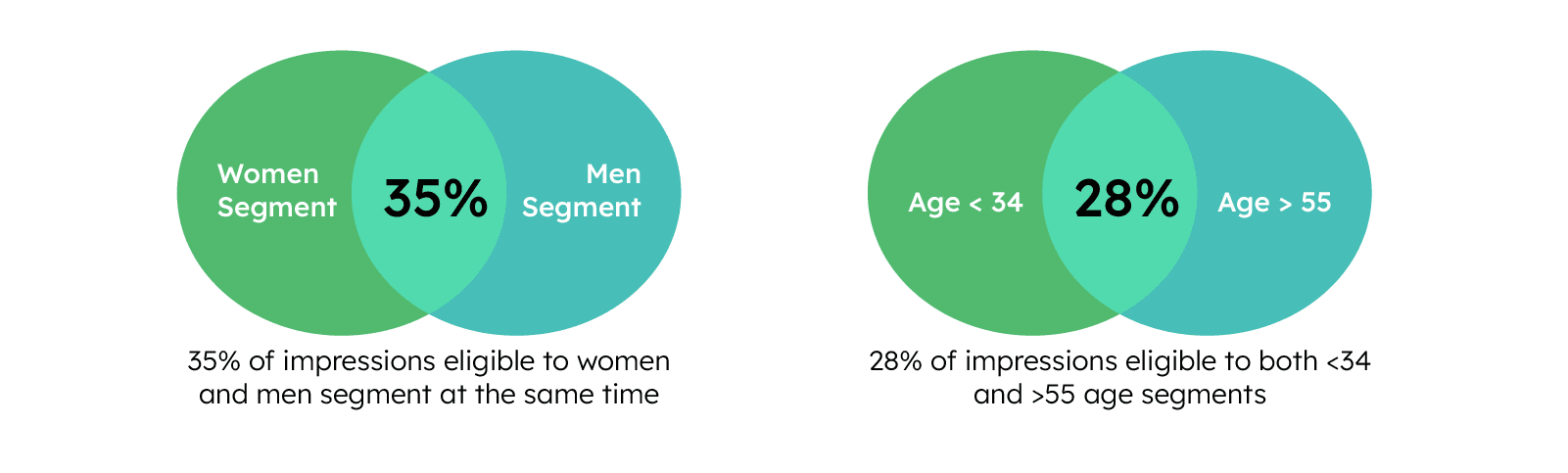
We analyzed a random sample of 151 032 impressions done to users who belonged to age and gender socio-demo segments and then assessed the share of users exposed that were eligible to multiple segments.
Results :
These overlaps indicate significant inaccuracies in the classification of users.
b. Do users confirm being part of the segments we targeted with cookie data ?
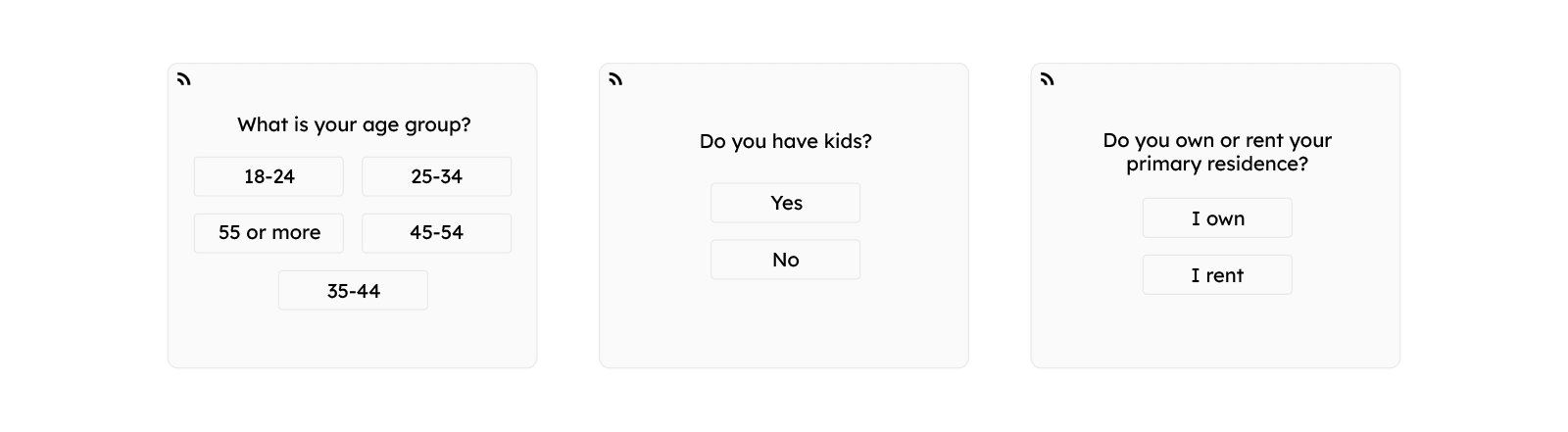
We targeted socio-demographic segments from popular data providers and displayed banners asking users to self-report their socio-demographic details. Responses were then compared with their assigned segments.
Protocol:

Examples of survey banners displayed to users:
Results:
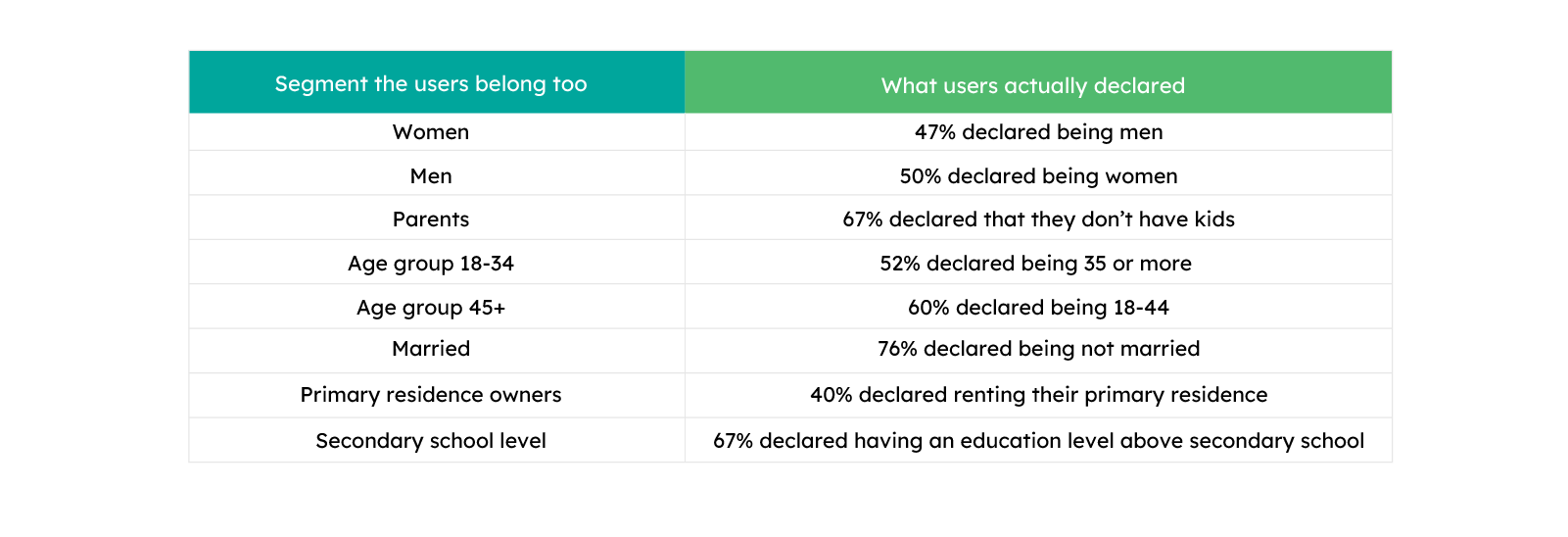
When analyzing specific segments and comparing them to the full sample of users, including those outside these socio-demographic segments, the results show no improvement over the full sample. This suggests that socio-demographics targeting may not provide added value.
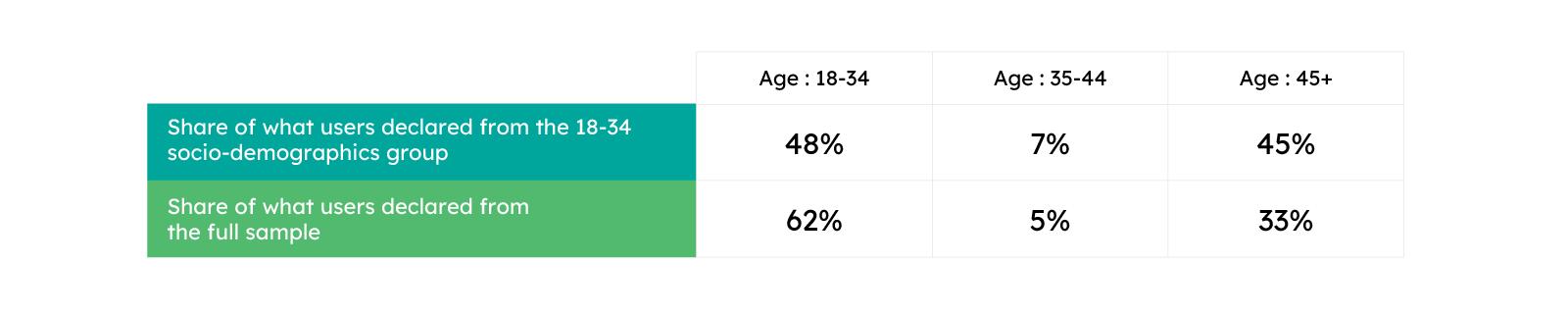
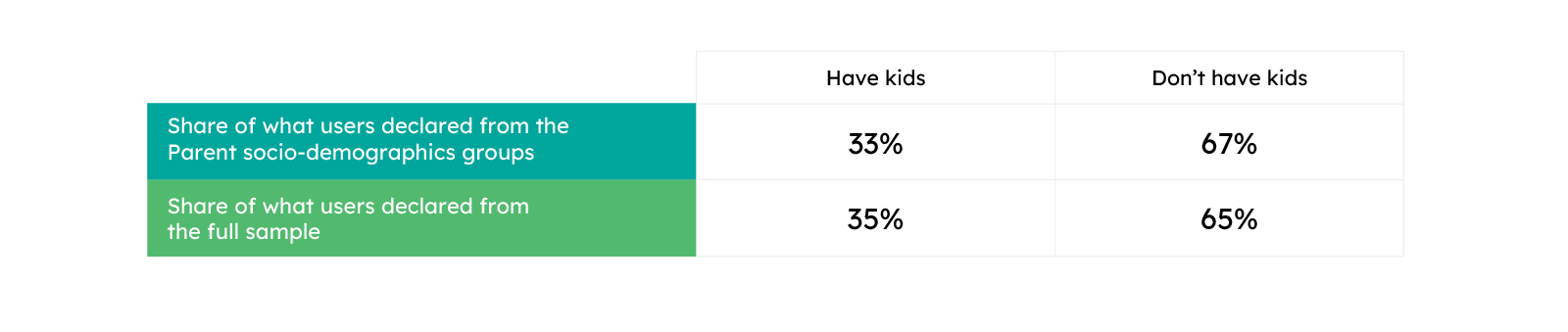
Further analysis indicates that targeting more specific segments leads to increased inaccuracies. For instance, when focusing on socio-demographic segments such as women aged 18-24, the accuracy decreases significantly, with precision dropping to around 18%. This is due to compounded inaccuracies in both gender and age data. A similar issue arises when targeting segments like ‘Moms,’ where the majority are not mothers, and a notable portion of the segment is inaccurately composed of men.
3. Conclusions of the studies:
The findings from both studies unequivocally demonstrate that socio-demographic targeting is inherently flawed. Over half of users belonged to overlapping age groups or contradictory gender segments, invalidating the concept of mutual exclusivity. Furthermore, self-reported data revealed negligible correlation with assigned segments, suggesting that socio-demographic data is either inherently inaccurate or quickly becomes outdated. As a result, segmentation often mirrors random selection rather than precise targeting.